

Last updated October 31, 2026
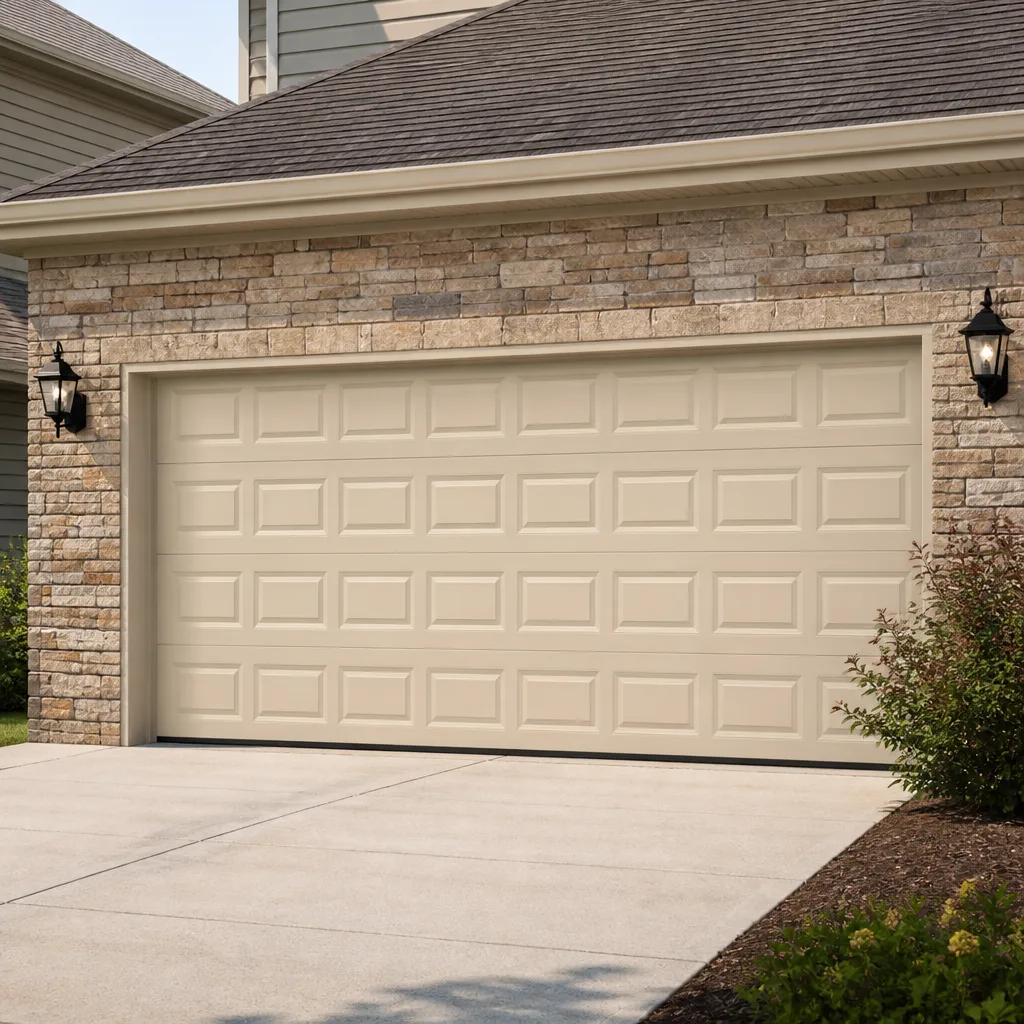 Raised-panel steel
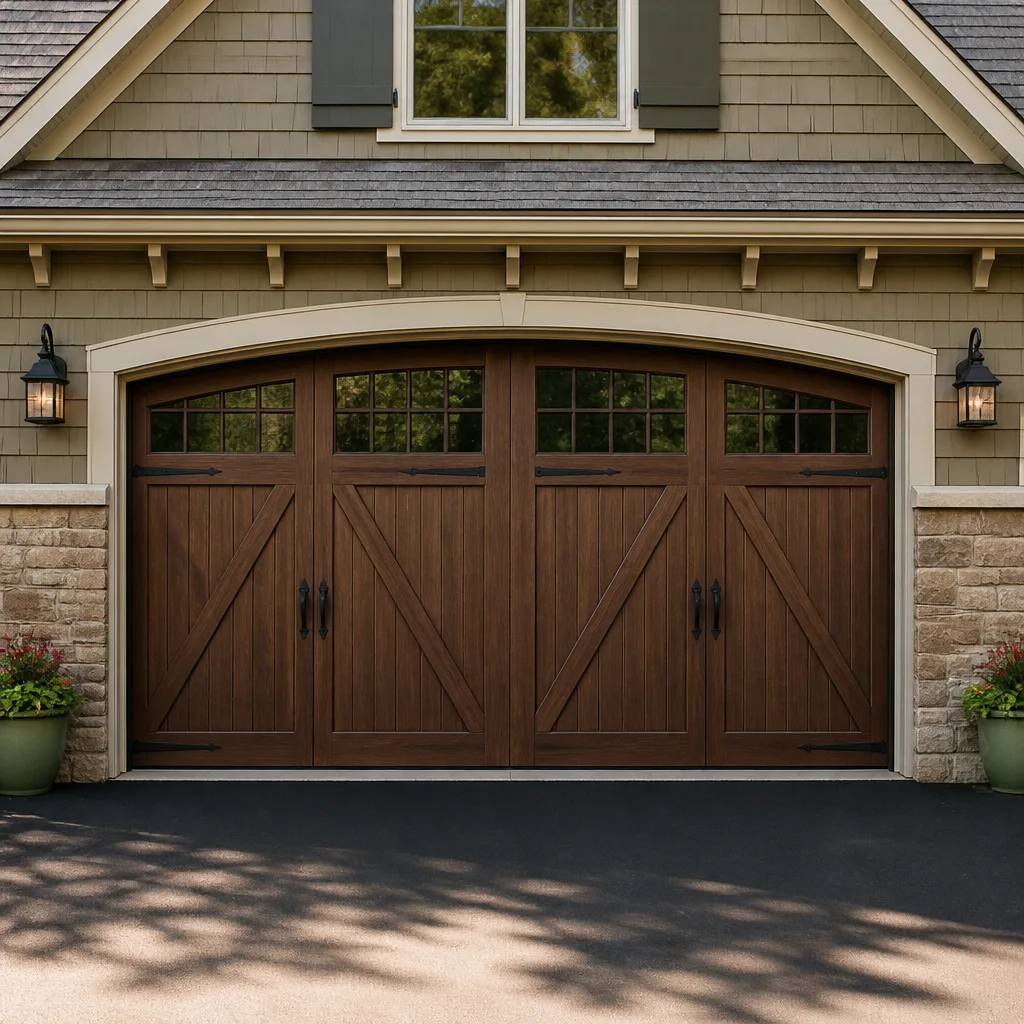 Carriage house
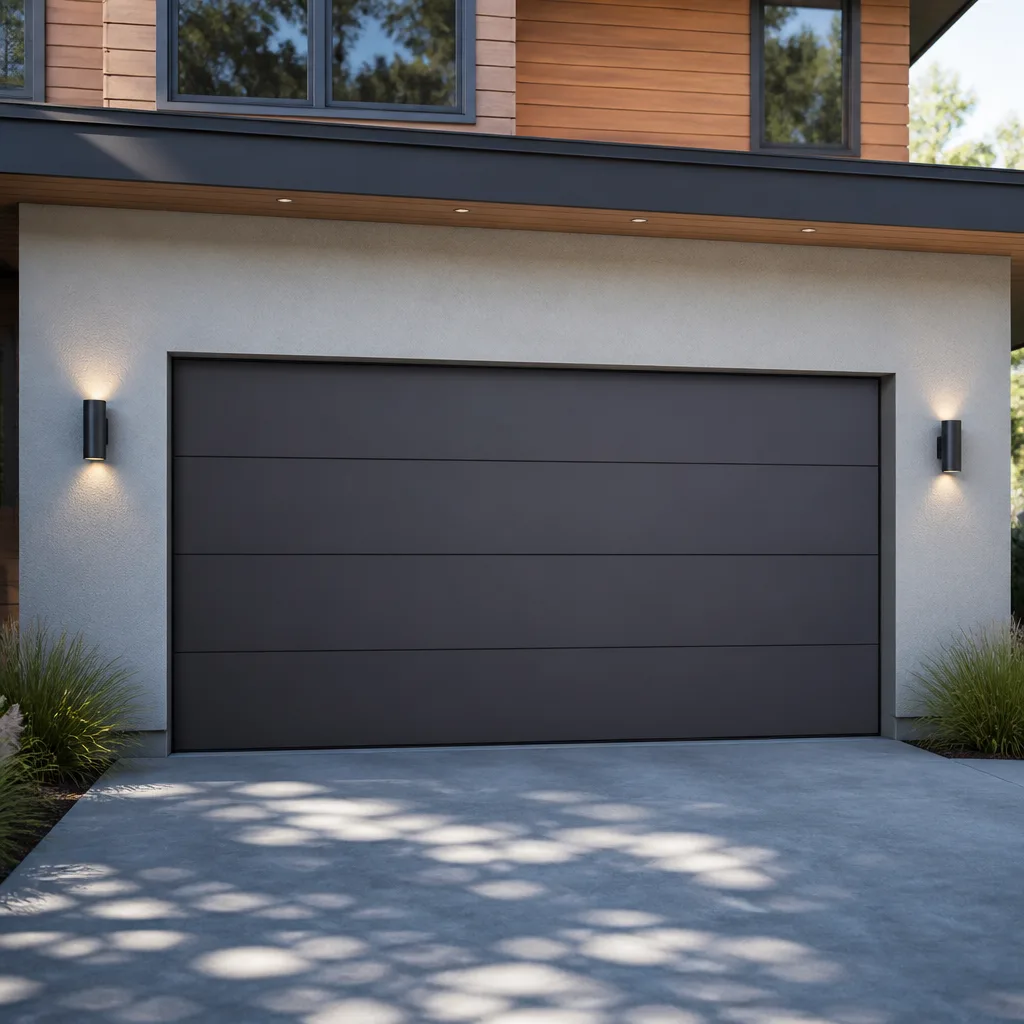 Modern flush
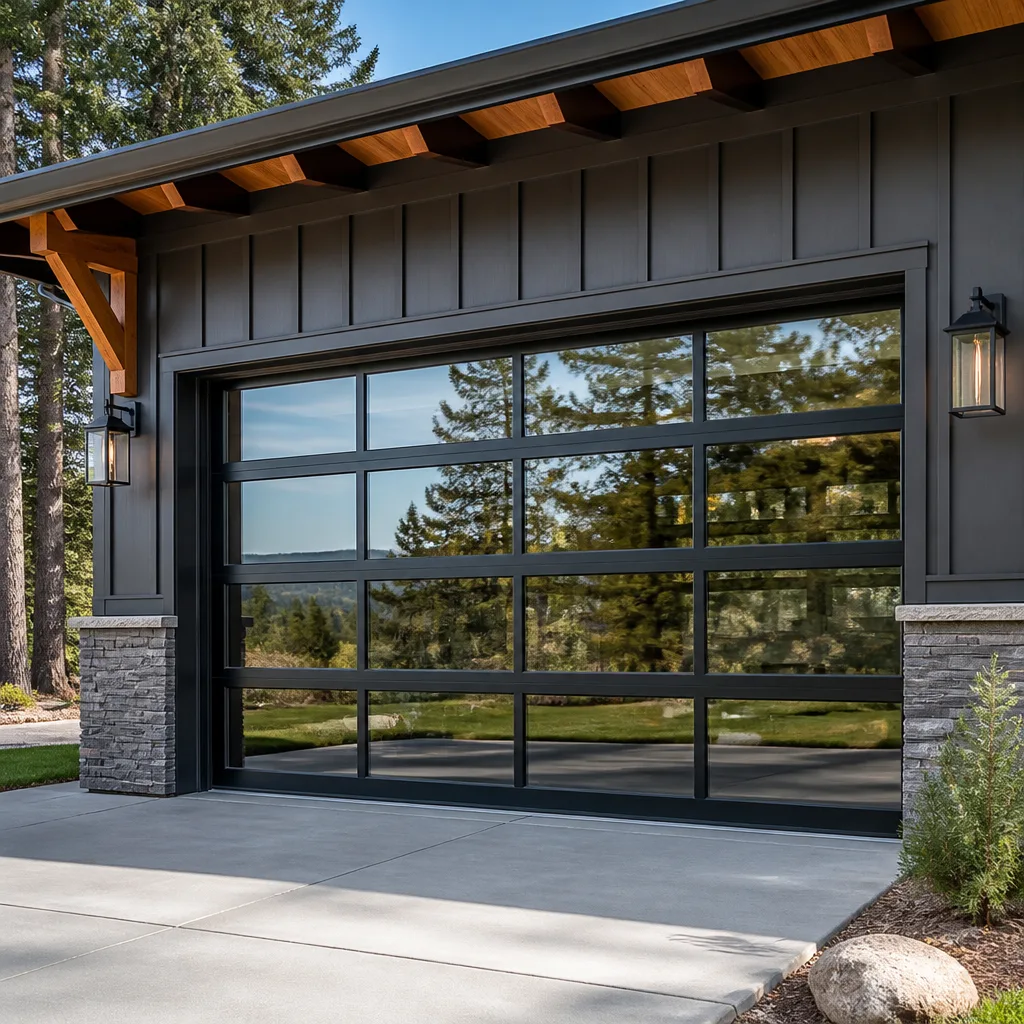 Full-view glass
 LiftMaster openers
 Chamberlain openers
Full 25-point door and opener safety check with every visit - springs, cables, rollers, tracks, and your LiftMaster or Chamberlain opener included
You get a price before we start. It does not change when the truck arrives.
Get your free estimateGarage Door Emergency Preparedness Guide for Sacramento Homes
During Sacramento’s September 2022 heat emergency, rolling blackouts left thousands of homeowners staring at garage doors that would not open. Cars sat trapped inside while temperatures climbed past 110 degrees. Most of those homeowners had no idea their opener had a manual release cord, and some who did know pulled it the wrong way: a broken tension spring plus an overhead door equals several hundred pounds of downward force, and yanking that red handle without bracing the door first has caused serious injuries in Sacramento garages. This guide covers the two emergency scenarios nobody talks about: heat-driven power failures and post-earthquake track damage. You’ll learn how to get your car out safely, when to leave the door alone, and what to check before you ever touch a release cord. For more guidance, see our Garage Door Repair Troubleshooting: Common Problems and How to Fix Them.
Quick Answer
Garage door emergencies in Sacramento fall into two patterns: power outages that disable openers during extreme heat, and earthquake damage that knocks doors off their tracks or loosens cables. The safe response in either case is to visually inspect the door, springs, and tracks before attempting a manual release, brace the door if you must open it, and call a technician when torsion springs are broken or the door has shifted off its rollers. For immediate help, call Carlton Garage Door Repair at (833) 589-6808.
Styles & brands we work with
Table of Contents
- Power Outage Protocol: Getting Your Car Out When the Opener Is Dead
- How to Use the Manual Release Cord Without Injuring Yourself
- Battery Backup Openers: What Works in Sacramento’s Heat
- Earthquake Response: Checking Tracks, Cables, and Frame Alignment
- Door Off Its Tracks With a Car Partially Inside: What to Do
- Building a 10-Minute Garage Emergency Kit
- Common Mistakes to Avoid
- When to Call a Professional
Power Outage Protocol: Getting Your Car Out When the Opener Is Dead
The most common garage door emergency in Sacramento is not a snapped spring. It is a dead opener during a heat-driven outage. Sacramento Municipal Utility District has implemented rotating outages during extreme heat events, and when power drops, your opener becomes a wall-mounted paperweight. But the door itself is still fully functional. It weighs between 130 and 400 pounds depending on size and material, and it operates on a balance system: torsion springs above the door or extension springs along the horizontal tracks counter most of that weight. When those springs are intact, a healthy adult can lift the door manually with one hand. When a spring is broken, the door becomes dangerously heavy, and that changes everything about how you respond.
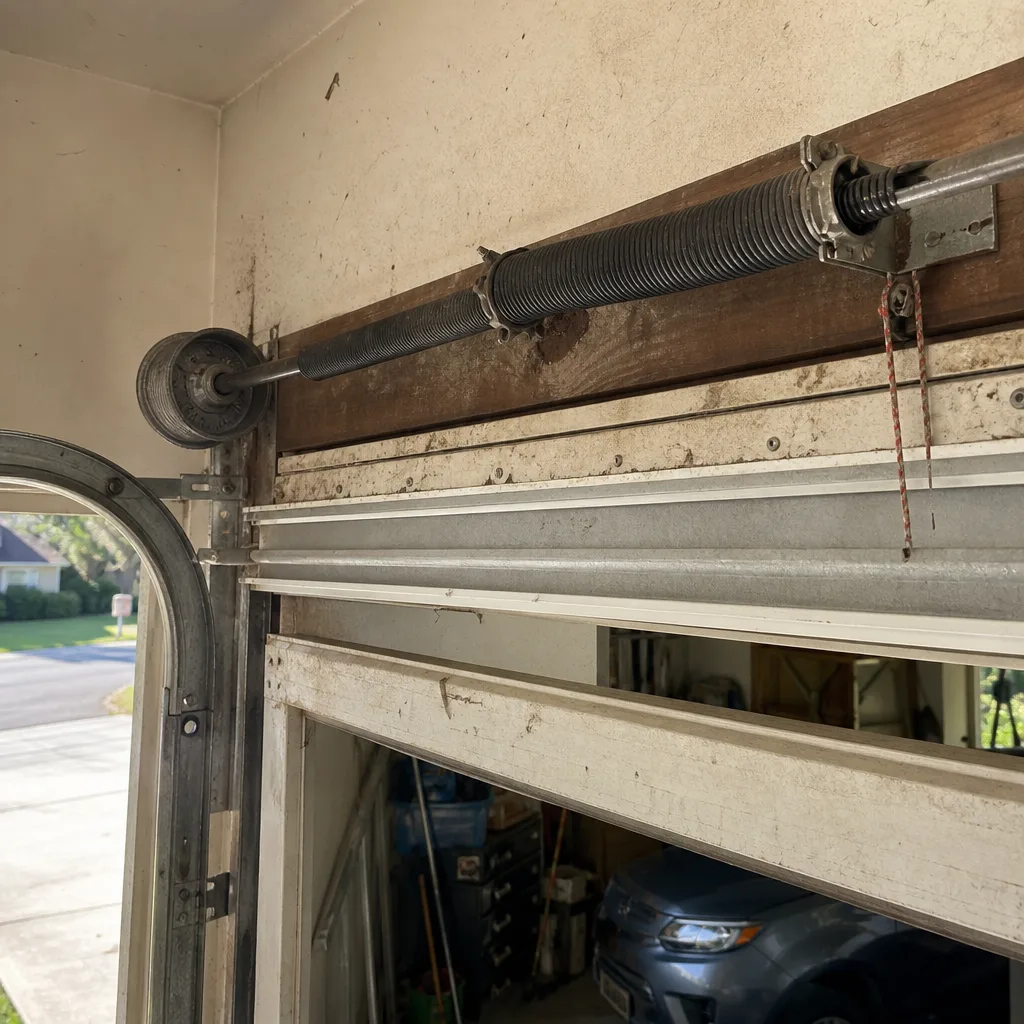
Before you pull any release cord, look at the springs. Torsion springs sit on a metal shaft directly above the closed door. If you see a gap in the coils, roughly a two-inch break in the spiral, the spring has failed. Extension springs stretch along the upper tracks on both sides. If one is dangling or separated into two pieces, that spring has failed. A door with a broken spring can still be opened, but it takes serious effort and carries real risk. One adult may be able to lift it with two hands and proper stance, but if the door slips, it drops fast. In our experience across Sacramento neighborhoods from Land Park to Natomas, post-outage injuries happen when someone assumes the door is balanced, releases it from the opener, and has the full weight come down on them. Check springs first. Always.
Once you have confirmed both springs look intact, the sequence is straightforward. Disconnect the opener by pulling the red release cord hanging from the center rail. This cord connects to a trolley that moves along the rail when the opener runs. Pulling it straight down disengages the trolley from the carriage. The door is now free of the opener mechanism. Lift the door using the handle at the bottom or the bottom edge. A balanced door should feel light and stay put when raised halfway. Open it fully and prop it secure if the springs feel weak or you plan to leave it open for more than a minute. Close it by walking it down with both hands. Reconnect the opener once power returns by running the opener until the trolley re-engages, or pull the release again and lift the door manually until it clicks back into place.
How to Use the Manual Release Cord Without Injuring Yourself
The red cord hanging from your opener rail is the emergency release, and in Sacramento it gets pulled most often during late summer blackouts. But the standard advice you find online (“just pull the cord and lift the door”) is incomplete and sometimes dangerous. The cord does not open the door. It disconnects the door from the opener’s motorized trolley. The door then moves by hand, and how safely it moves depends entirely on the condition of the springs.
- Stand to the side of the door, not directly underneath it. If the door falls or slams, you do not want to be in its path.
- Look up at the torsion spring or the extension springs before touching anything. If any spring shows a visible gap, a separation, or a dangling piece, leave the release cord alone and call a technician. A broken spring means the door may drop when released from the opener.
- If the springs look intact, grip the red cord and pull straight down in one firm motion. You will hear a click as the trolley disengages.
- Lift the door using both hands on the bottom edge or the handle. Keep your back straight and knees bent. The door should feel manageable. If it feels like more than 40 or 50 pounds of lift, stop. A spring may be fatigued even if it looks whole.
- Raise the door fully and guide it until it settles in the open position. If the door starts to drift downward on its own, the springs are not holding tension and the door needs service.
- To re-engage, pull down on the release cord again while the opener is running, or lift the door manually until the trolley clicks back into the carriage. The opener will function normally after that.
One more Sacramento-specific note: many homes built in the 1960s and 1970s in Arden-Arcade and South Land Park still have original torsion springs. Torsion springs are rated for a cycle life, typically 10,000 cycles for standard springs. After 40 or 50 years, a spring that looks fine may simply be worn past its rated life and ready to fail on the next cycle. If your spring is older than 15 years and you have never had it inspected, it is a candidate for replacement before it strands your car again.
Battery Backup Openers: What Works in Sacramento’s Heat
Since 2019, California building code (Title 24, Part 6) requires battery backup on all newly installed residential garage door openers. That means if you installed an opener after 2019 through a licensed contractor, you likely already have battery backup. If your opener is older, you may not. Sacramento’s climate matters here because heat is the enemy of battery chemistry. Backup batteries in non-climate-controlled garages degrade faster when ambient temperatures cycle from 50 degrees in January to 115 degrees in August. We regularly see batteries in Sacramento garages with a three-year rated life that fail by year two. If your opener has a backup battery, test it. Disconnect the opener from power (unplug it or flip its breaker) and run the opener on battery alone. A healthy backup should cycle the door several times. If the door moves slowly or the opener beeps and refuses to run, the battery has aged out.
If you are considering a battery backup opener, the two most common systems in Sacramento are the LiftMaster 87504 and the Chamberlain B6753T. Both integrate with smart home platforms and include backup power. Genie’s Aladdin Connect openers with integrated battery backup appear frequently in newer Sacramento subdivisions in Elk Grove and Folsom. The key compatibility question is rail type: belt drive, chain drive, or screw drive. Your existing rail and door weight determine whether you can swap only the powerhead or need a full rail replacement. A door that weighs 300 pounds on a worn chain rail is a poor candidate for a motor-swap, while a standard aluminum door on a belt rail typically swaps without issue.
For homeowners who do not want to replace their opener, a simpler solution is a manual release plan. Know where the cord is, test the manual lift before an outage, and keep the springs in good repair. That costs nothing and works every time the power drops. Carlton Garage Door Repair handles Garage Door Opener Repair in Sacramento including battery diagnostics and replacement, and we service openers from LiftMaster, Chamberlain, Genie, and Craftsman without steering you toward a particular brand.
Earthquake Response: Checking Tracks, Cables, and Frame Alignment
Sacramento sits far enough from the San Andreas Fault that major structural damage is uncommon, but the city does feel significant shaking from Bay Area events and from faults in the Sierra foothills. A magnitude 6 or larger quake on the Hayward Fault would produce noticeable movement in Sacramento, and that movement is exactly what damages garage door systems. The door hangs on steel tracks bolted to the wall framing and header. When the frame shifts even a quarter inch, the tracks can bow, twist, or separate from their brackets. Cables that run alongside the tracks can slip off their drums. The result is a door that binds, jams, or sits visibly crooked in its opening.
After any earthquake that you feel in the house, check the garage door before operating it. Walk the interior and look at both vertical tracks. The gap between the track and the door edge should be uniform from floor to ceiling. If one track appears twisted, if a track bracket has pulled away from the wall, or if the horizontal track above the door looks bent, do not run the opener. The opener will force the rollers through misaligned track, which can pop a roller out, kink the track, or snap a cable.
Next, inspect the lift cables. These are the steel cables that run from the bottom brackets up to the drums on the torsion shaft. With the door closed, both cables should be taut. If one cable has slack, the door is lifting on one side only, which will rack the sections and could pull the door off its tracks on the slack side. A slack cable after an earthquake usually means either a shifted drum or a door panel that has twisted relative to the frame. Either condition calls for a technician. Do not attempt to re-seat a cable on a torsion spring drum. The drum is under spring tension, and prying at it without winding the spring properly can cause the spring to unload violently.
The last check is visual alignment from outside. Stand across the street and look at the garage door relative to the opening. A door that sits lower on one side, shows a larger gap at one side of the header, or appears to bow outward from the frame has a structural alignment problem. Operating the door in that condition will damage rollers, hinges, and possibly the opener rail. In older Sacramento neighborhoods like Curtis Park and East Sacramento, where homes may have original wood framing, post-earthquake door misalignment can signal a shifting header rather than a door problem. In that case, a garage door technician can identify the issue but may recommend a framing contractor to address the root cause.
For structural door issues after seismic events, our Garage Door Repair in Sacramento service includes track realignment, cable correction, and full system inspection.
Door Off Its Tracks With a Car Partially Inside: What to Do
This is the scariest garage door scenario in Sacramento, and it happens more often than you’d think: someone starts backing out while the door is only partially open, or the door comes off its track while a car is halfway through the opening. The car is stuck. The door is jammed against the roof or the car. Everything feels wrong, and the instinct is to hit the opener button. Do not do that. The opener is now pulling against a door that has no track alignment, which means the opener is pulling against itself, the car, or both. You risk bending the opener rail, damaging the door panels, or having the door drop onto the car roof.
The first step is to disconnect the opener. Pull the red release cord if you can reach it safely. This takes the motor out of the equation. Then assess whether the door is resting on the car or on the opening. If the door is resting on the car, do not attempt to move it. Every inch of movement can scratch the roof or shatter a rear window. Leave everything in place and call a technician. If the door is off its track but not touching the car, you may be able to move the car forward or backward slowly while a second person watches the door. The goal is to create clearance, not to extract the car at all costs.
Once the car is moved or if the car is not involved, resist the urge to “pop” the door back onto the track. A typical 16-foot sectional door weighs 200 to 300 pounds, and the rollers are under tension when the door is misaligned. Forcing a roller back into a bent track usually bends the track further or breaks the roller stem. The correct repair sequence is: remove tension from the springs, reset the rollers in the track, straighten or replace the track section, re-tension the springs. That is skilled work that requires winding bars and an understanding of torsion spring mechanics. We work on doors from Clopay, Amarr, Wayne Dalton, and Raynor, and the repair process is similar across brands, but the specific roller size and track profile vary enough that a one-size-fits-all approach fails. This is where our multi-brand familiarity pays off: the same off-track problem on an Amarr door and a Raynor door may need different replacement rollers and a different re-seating technique.
For help with an off-track door, call Carlton Garage Door Repair home at (833) 589-6808. We quote the repair cost before any work starts, and the technician arrives with the rollers, hinges, and track sections needed for the common failure modes.
Building a 10-Minute Garage Emergency Kit
Most Sacramento homeowners already have the raw materials for an emergency kit scattered across the garage. The problem is finding them in the dark during a blackout, with a phone at 3% battery and a car stuck inside. A dedicated kit, assembled on a Saturday morning in ten minutes, solves that. Here is what belongs in it. For a full breakdown, see our Garage Door Repair Maintenance Checklist for Sacramento Homeowners.
- A headlamp or magnetic LED work light. Power outages happen at night. Holding a flashlight while lifting a garage door does not work. A headlamp keeps both hands free.
- A 12-inch length of 2×4 lumber. Use it as a prop to hold the door open if you need to work under it or leave it open during an outage. Never trust the springs to hold a door open when you are underneath it.
- Vise grips or a C-clamp. Clamp these to the track just above a raised roller to lock the door in place. This is the standard professional method for securing a door in the open position.
- Leather work gloves. Garage door edges are sharp, cables are steel, and track brackets can cut skin. Gloves are non-negotiable for any manual door handling.
- Spare opener remote batteries. CR2032 is the common type for most remotes and keypads. Keep a two-pack in the kit.
- Spare key for the pedestrian door. The garage may be accessible through a side door or a door from the house. If that door is locked and the opener is dead, having a key means you can reach the release cord from inside.
- Your garage service phone number. Write Carlton Garage Door Repair, (833) 589-6808, on a label inside the kit. In an emergency, you will not remember to look it up.
You will also want to keep the opener’s release cord itself in good shape. Release cords wear out after ten or fifteen years. A frayed cord can snap when pulled, which leaves you with no manual release at all. Tying a longer pull cord to the existing handle is cheap insurance, but make sure the extension does not hang low enough to be snagged by a car roof rack.
Common Mistakes to Avoid
- Pulling the release cord while the door is open. This disconnects a door that is under full spring tension with nothing supporting it except the opener. The door will slam shut. Always release the opener when the door is fully closed, or brace the door first if it is open.
- Using the opener immediately after an earthquake. Even if the shaking felt mild, the opener will force the door through any shifted track. Inspect first. Operate second.
- Assuming a spring is fine because it looks okay. Torsion springs can fracture internally or fail at the winding cone while looking pristine from a distance. A door that feels heavy, creaks on movement, or snaps open or closed is telling you the spring is done. Listen to it.
- Attempting a cable re-seat without understanding spring tension. The cables on a torsion system are under the same tension as the spring. A slip while attempting to re-seat a cable can cause the spring to spin out its entire stored energy in a fraction of a second. This is one of the few home repair tasks that genuinely deserves a pro.
- Leaving the garage door open during a heat wave and forgetting the car. Open doors invite theft in any neighborhood. If you must leave the door open during a prolonged outage, secure it with vise grips on the track and lock the interior door to the house.
- Testing the opener backup battery by unplugging the opener and running it once. One successful cycle does not prove the battery is healthy. Load-test it with several full cycles. A battery that weakens after one open will strand you on the next outage.
- Using the garage as the only exit strategy for an emergency. If a car is in the garage and the opener is dead, you may need to move the car manually. But the pedestrian door or front door is almost always faster. Know your escape routes before an emergency, not during one.
When to Call a Professional
Some garage door emergencies resolve with a manual release and a little patience. Others become immediately more dangerous the moment you touch them. Call a professional when you see a broken torsion spring or extension spring, when a cable has slipped off its drum, when the door is visibly crooked in the opening, when the door has come off its tracks, or when the door drops suddenly during manual operation. These all indicate a loss of spring tension or track integrity, and operating the door in that state risks injury and further damage. If you are unsure whether the door is safe to lift, treat it as unsafe. The cost of a service call in Sacramento is almost always lower than a visit to urgent care or a repair bill for a door that fell onto a car. Carlton Garage Door Repair offers free estimates in Sacramento, and we service the brand you already own, from a snapped spring to a full Garage Door Installation in Sacramento. Call (833) 589-6808.
See the difference
 Before
 After
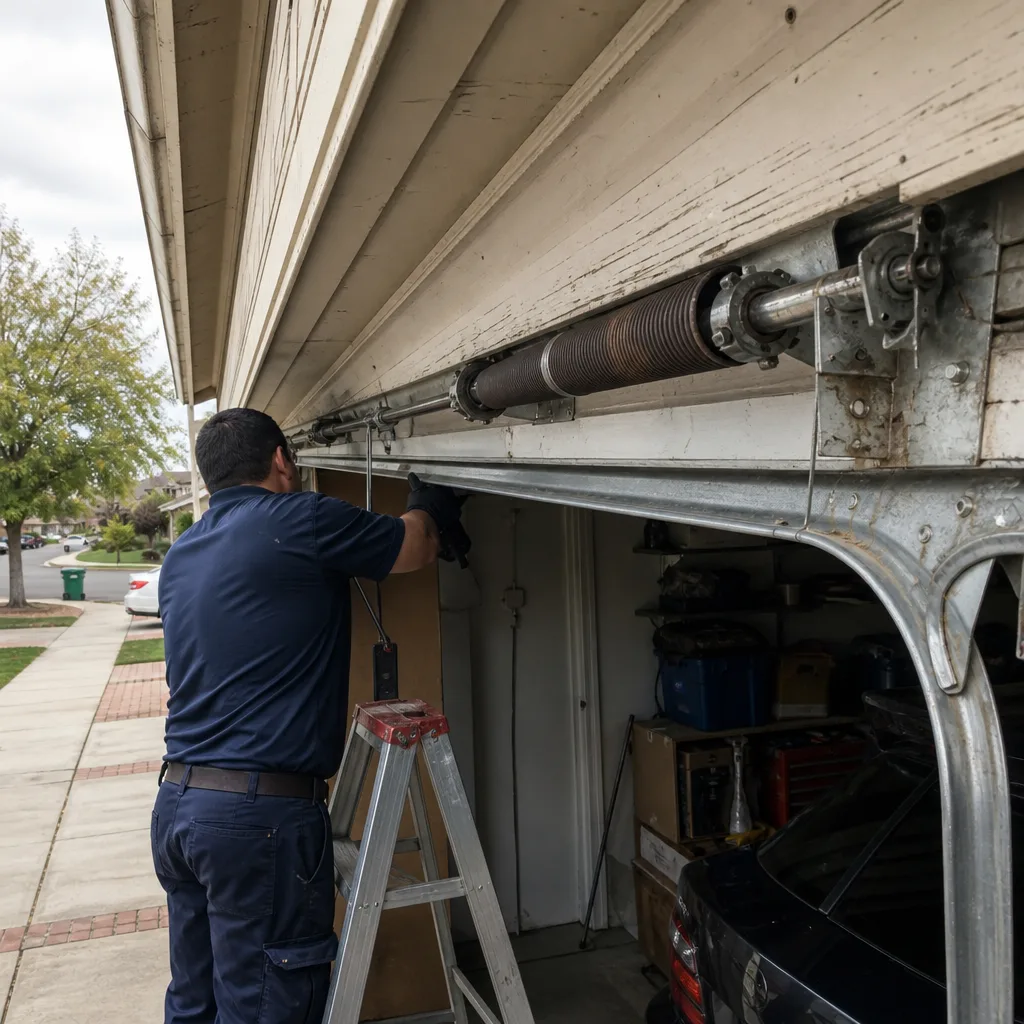 Before
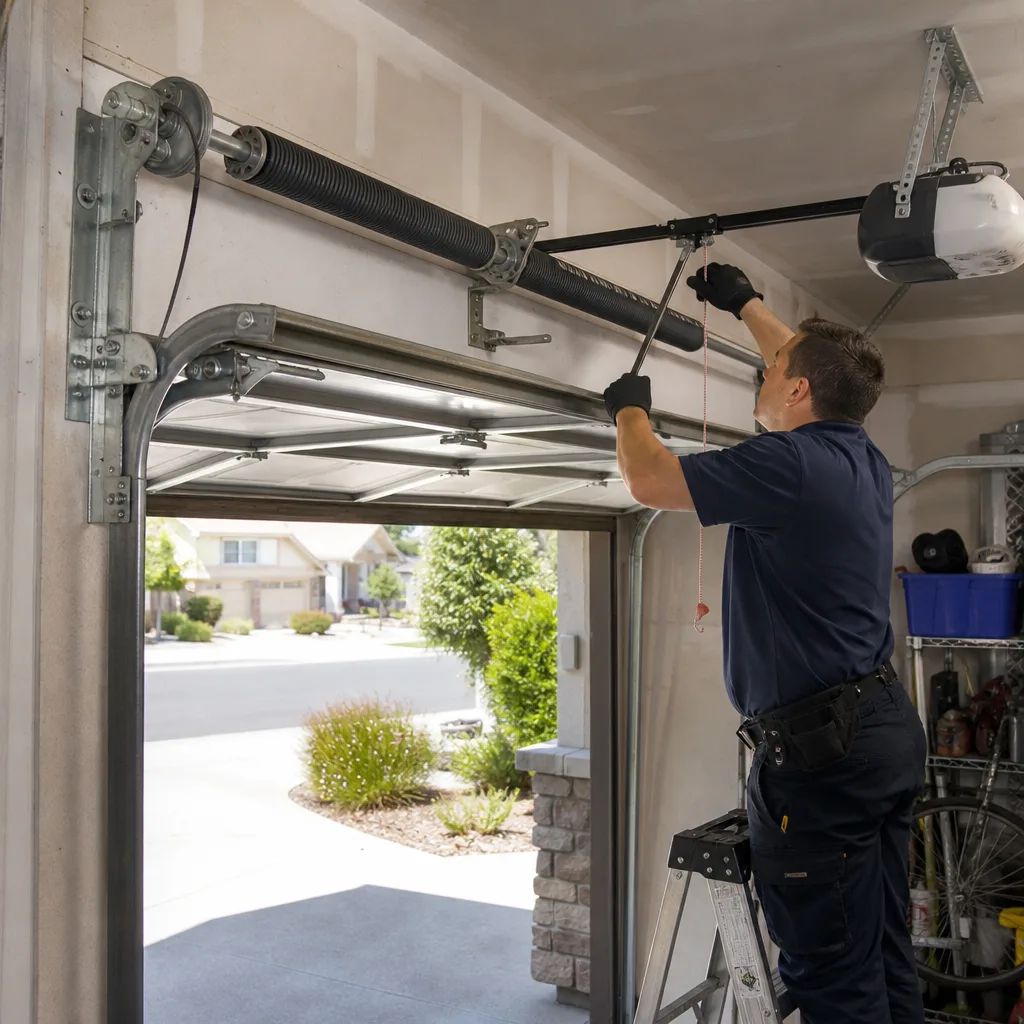 After
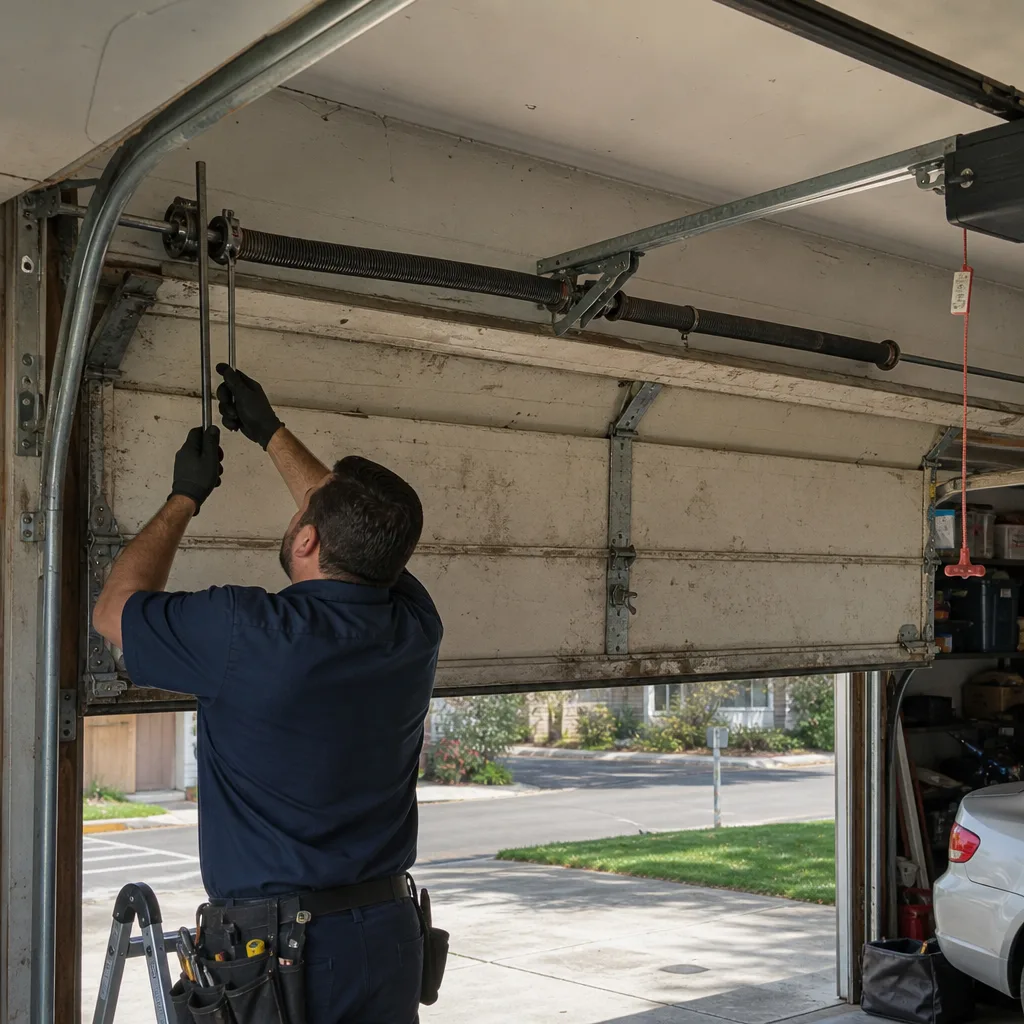 Before
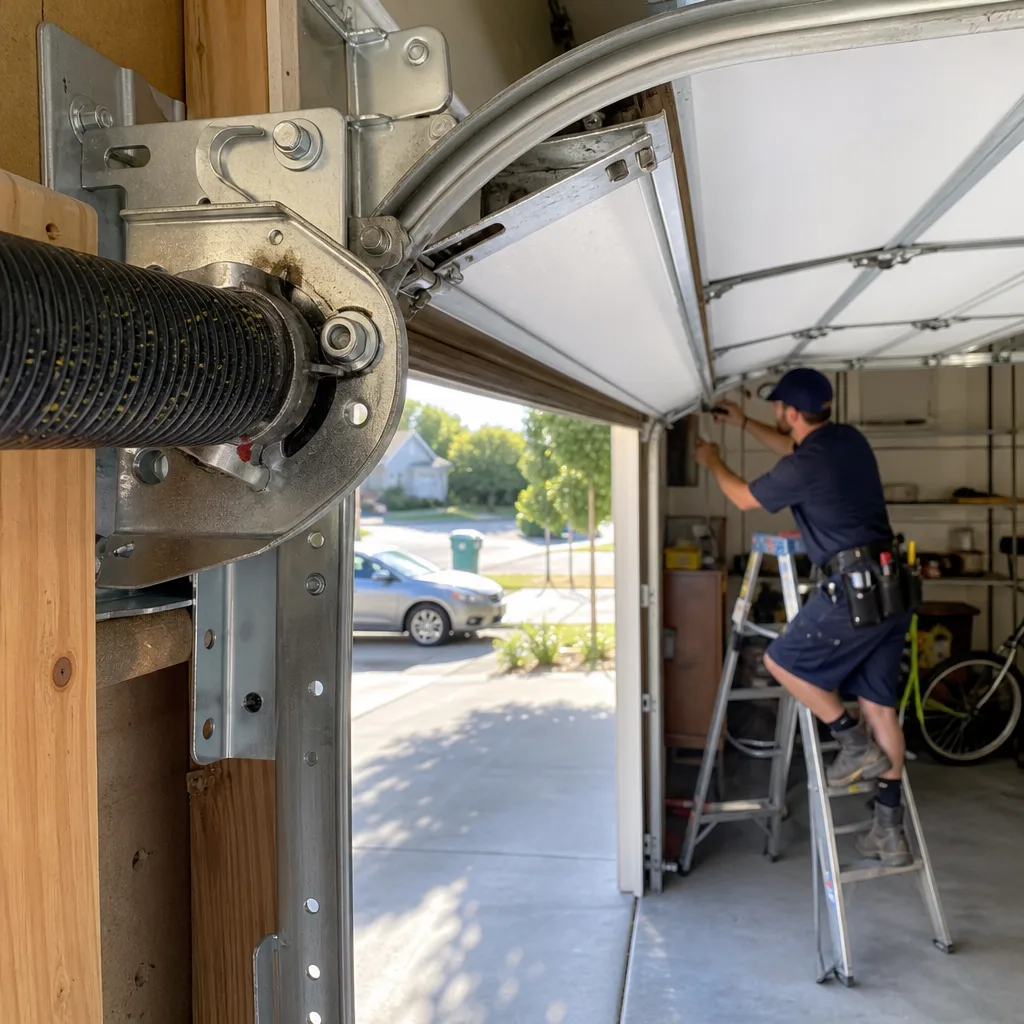 After
Frequently Asked Questions
Pull the red emergency release cord hanging from the opener rail to disconnect the door from the motor, then lift the door by hand using its bottom edge or handle. This works only if the springs are intact; a door with a broken spring may be too heavy to lift safely. For a door that won’t budge or feels excessively heavy, call (833) 589-6808 rather than forcing it.
Yes. California building code has required battery backup on all newly installed residential garage door openers since 2019. If your opener was installed after that date, it should have backup capability. Homes with older openers typically do not, and a battery backup retrofit means installing a new opener powerhead or full unit.
Heat-driven power outages are the most common emergency trigger in Sacramento, and they typically just require the manual release. Broken torsion springs are the most common physical failure we see across the city, often after years of Sacramento temperature cycles that weaken spring steel. Both problems are diagnosed quickly, and our trucks carry the parts to address them same-day.
Typical emergency service calls in Sacramento run from $120 to $250 for labor and diagnostics, with parts like torsion springs adding $150 to $300 depending on spring size and door weight. Off-track repairs tend to land between $180 and $350. Every quote is agreed before any work starts. Call (833) 589-6808 for a free estimate on your specific door.
Yes. Off-track doors are one of the most common same-day repairs we handle in Sacramento. The repair involves releasing spring tension, resetting rollers in the track, straightening or replacing damaged sections, and re-tensioning the system. We service Clopay, Amarr, Wayne Dalton, and Raynor doors, and the parts needed depend on which brand and track profile you have.
Only after a visual inspection of the tracks, cables, and overall door alignment. If the door looks crooked, a cable is slack, or a track is bent or separated from the wall, do not operate the door. Call a technician. Most post-earthquake door problems in Sacramento are track and cable issues rather than spring failures, and they are repairable.
No. We quote the repair cost after inspecting the door, and that quote is the price you pay before any work begins. If additional issues are discovered during repair, we explain them and get your approval before adding any work. There are no surprises on the invoice. Call (833) 589-6808 and we will walk through what to expect.
The Bottom Line
Sacramento garage door emergencies split into two camps: electrical failures during heat events and structural problems after earthquakes. Both are manageable if you understand what you are looking at, and if you need Garage Door Permits, Codes & Inspections in CA: What You Need to Know, we have you covered. Check the springs before pulling the release cord. Inspect tracks and cables after any shaking. Keep a small emergency kit accessible. And know which problems are too dangerous to handle yourself: broken springs under tension, cables off drums, doors off tracks. These are moments when a technician is the only safe answer. Carlton Garage Door Repair brings brand-specific knowledge to whatever system you have, from Craftsman openers to Raynor doors. For a free estimate or emergency help anywhere in Sacramento, call (833) 589-6808.
Written by the team at Carlton Garage Door Repair, serving Sacramento since 2012.